

Piccolo Journal: What does it mean to you to deliver a Piccolo House project?
Toby Earle: The expectations are high now – and they should be. Over the years, Piccolo has built a reputation for quality, and with that comes a responsibility to continue that legacy. Each project has to stand the test of time. It needs to be low maintenance in its materials, timeless in design, and resolved through clever detailing that genuinely reflects quality.
Every project we do gets better. Not because we’ve made mistakes in the past, but because we’re always refining what we do and pushing the standard higher. That consistency is important. It doesn’t matter the scale – the level of finish and care has to be the same.
What can you share about the kind of details that make a Piccolo house project unique?
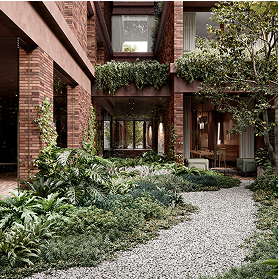
Detailing is really about reduction. In a few of our projects over the years we’ve used brickwork in different ways – often combining several brick materials that are quite distinct, but detailing them so they read as seamless. The aim is always to reduce what you see.
When you start joining things together – plaster, brick, windows – that’s where visual clutter can creep in. We work hard to pare things back to the minimum. Fewer lines, fewer junctions, less disorder. That’s where the quality comes through. It’s also more efficient, because good detailing can reduce the number of trades involved and simplify the build.
You’re very hands-on throughout the process. What does that look like day to day?
My role runs from the very beginning – from inception – right through to delivery on site. In the last nine months of a project, we maintain a continuous presence on site. We’re not dipping in and out.
We usually set the benchmark by completing one apartment first and treating it as a working prototype. Every detail is resolved there. Once we’re happy with that standard, it becomes the reference point for the rest of the building, and we make sure that level of quality is maintained throughout.
Because we’re on site, we can respond quickly. We’re working closely with the designers and architects, reviewing all the drawings, and if something isn’t fully documented, we can give clear direction on how it should be done. There’s also a lot of customisation in Piccolo House apartments – subtle changes that homeowner’s make to personalise each residence – and that requires a high level of involvement.
How does that involvement extend beyond completion?
We’re there before, during and after. I personally inspect every apartment. We won’t allow a resident through until it reaches the standard we’re happy with. We open every drawer, every cupboard.
After people move in, there are always small things that only show up once a space is lived in – a creak here, a minor adjustment there. Those first three months are important. We have a team ready to go, and we stay involved to make sure any niggling issues are addressed.
We also act as the interface between the homeowner and the builder, making sure communication is clear and expectations are met on both sides.
You often work with the same collaborators, including builders, what’s the benefit of that?
Working with trusted, repeat builders makes a big difference. Builders like Hamilton Marino, who we’ve just finished 385 Gore St, Fitzroy with, understand what we’re about. There’s no need to re-educate them on the level of quality we expect because they’re already there.
Is there a particular moment in the process you look forward to?
There’s a real satisfaction in seeing it all come together. I come from a background in architecture, and I’ve worked across architecture, design and interiors, so I genuinely love the process.
At the end of the day we’re problem solvers, and working through everything to see the final outcome is incredibly rewarding. But the best part is seeing people live in these spaces. Walking into a building like 385 Gore St, Fitzroy, where you can move through 49 apartments and everything feels resolved – that’s huge.
There are so many stakeholders involved and then suddenly it all comes to life at once. It’s hard to appreciate along the way how it will all work together, until it does.